
Heart disease is one of the major health concerns affecting people across different age groups. Coronary artery disease (CAD), in particular, occurs when the blood vessels supplying oxygen-rich blood to the heart become narrowed or blocked due to plaque buildup. When the condition becomes severe, doctors may recommend coronary artery bypass grafting (CABG) to improve blood flow to the heart muscle.
Over the years, advancements in cardiac surgery have introduced different techniques for performing bypass procedures. One such approach is LIMA RIMA Y grafting, a specialised surgical technique that uses two internal mammary arteries to create a composite graft for coronary artery bypass surgery.
This technique is also associated with bilateral internal mammary artery (BIMA) grafting and may be considered for selected patients who require surgical treatment for multivessel coronary artery disease.
Understanding how LIMA RIMA Y grafting works, its potential advantages and the factors involved in selecting this procedure can help patients make informed decisions about their heart treatment.
What Is LIMA RIMA Y Grafting?
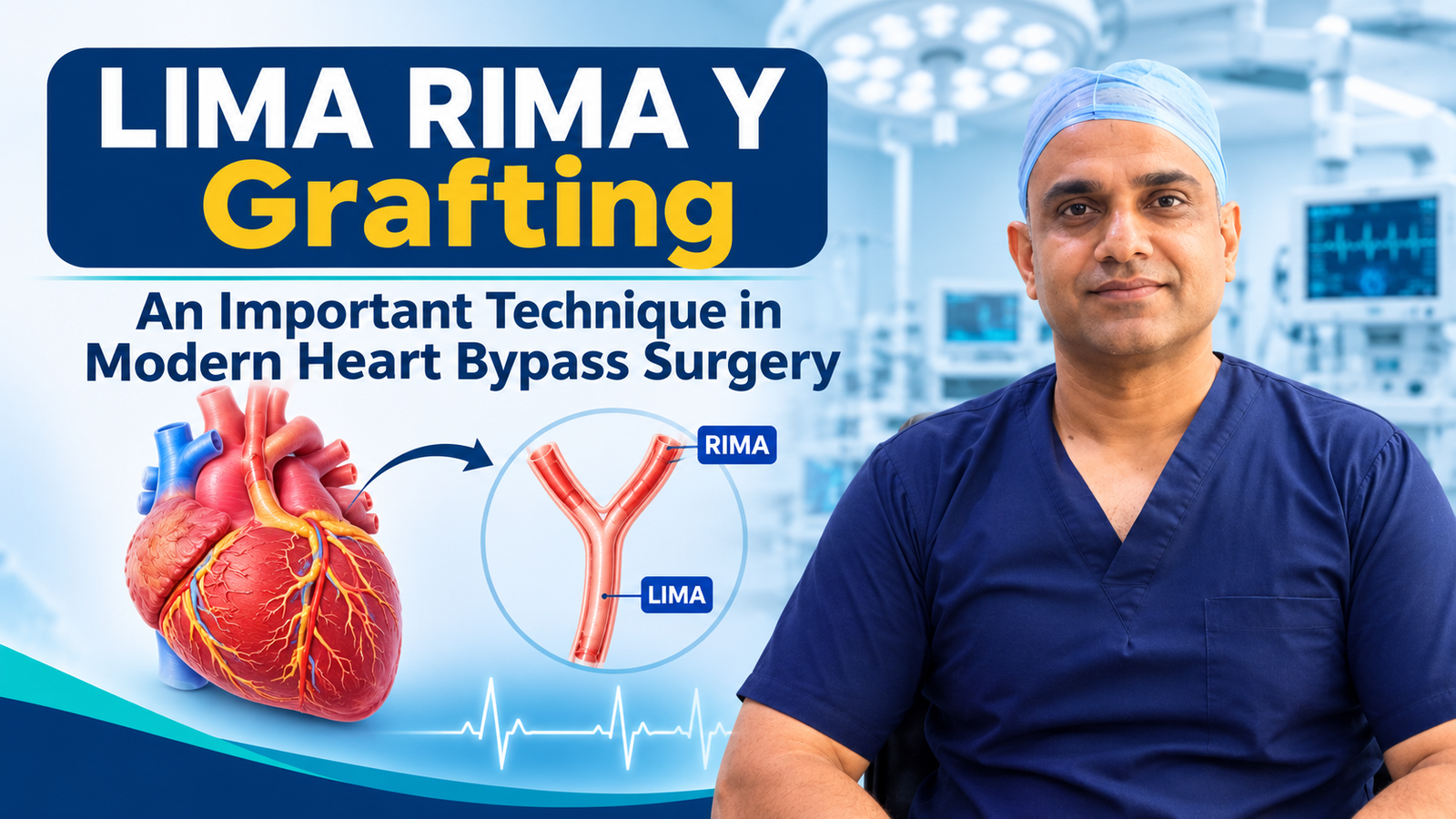
LIMA RIMA Y grafting is a specialised approach used during coronary artery bypass surgery. It involves using the Left Internal Mammary Artery (LIMA) and Right Internal Mammary Artery (RIMA) to create a Y-shaped composite graft.
The LIMA is commonly used to bypass the Left Anterior Descending (LAD) coronary artery, which supplies blood to a significant portion of the heart muscle. In a composite Y-graft configuration, the RIMA is connected to the LIMA, creating an additional pathway that can supply blood to other selected coronary arteries.
The resulting graft resembles the letter Y, with the LIMA serving as the main inflow conduit and the RIMA forming a branch.
This approach allows surgeons to use both internal mammary arteries for multiple coronary targets. The specific configuration depends on the patient’s coronary anatomy, the location of blockages and the surgeon’s assessment.
Understanding LIMA and RIMA in Heart Bypass Surgery
To understand the importance of LIMA RIMA Y grafting, it is helpful to know the role of both arteries in cardiac surgery.
Left Internal Mammary Artery (LIMA)
The Left Internal Mammary Artery, also known as the Left Internal Thoracic Artery, runs along the inside of the chest wall.
It is widely used in coronary artery bypass surgery, particularly for bypassing the Left Anterior Descending (LAD) artery.
The LIMA is valued because of its favourable long-term graft performance and biological characteristics. Its use for LAD bypass is an established component of modern CABG.
Right Internal Mammary Artery (RIMA)
The Right Internal Mammary Artery runs along the right side of the chest wall.
It can be used as another arterial conduit during bypass surgery. Depending on the surgical plan, it may be used as an in-situ graft or connected to the LIMA to create a composite Y-graft.
Using both arteries can allow surgeons to plan multiple arterial bypass connections in selected patients.
How Does LIMA RIMA Y Grafting Work?
LIMA RIMA Y grafting involves carefully connecting the two internal mammary arteries to create a composite graft.
The procedure generally includes the following steps:
1. Preoperative Cardiac Evaluation
Before surgery, the cardiac team evaluates the patient’s overall health and the severity of coronary artery disease.
Investigations may include coronary angiography, echocardiography, ECG, blood tests and other diagnostic assessments.
These findings help the surgeon identify blocked coronary arteries and determine whether bilateral internal mammary artery grafting is appropriate.
2. Preparation of the Internal Mammary Arteries
During surgery, the surgeon carefully prepares the LIMA and RIMA for use as bypass conduits.
The arteries may be harvested using different surgical techniques, including skeletonised harvesting, depending on the patient’s condition and the surgical approach.
Careful handling is important to preserve the quality and function of the grafts.
3. Creation of the Y-Shaped Graft
In the composite Y-graft technique, the RIMA is connected to the LIMA through a carefully constructed surgical connection called an anastomosis.
This creates a Y-shaped configuration that allows blood entering through the LIMA to flow through the connected RIMA branch.
4. Connecting the Grafts to Coronary Arteries
The surgeon connects the prepared arterial grafts to selected coronary arteries beyond the narrowed or blocked sections.
The LIMA is commonly used for the LAD, while the RIMA branch may be used to supply other suitable coronary targets.
The exact arrangement depends on the patient’s coronary anatomy and the surgeon’s operative plan.
5. Assessment of Blood Flow
After the connections are completed, the surgical team assesses graft flow and checks the connections to ensure they are functioning appropriately.
The patient is then transferred for postoperative monitoring and cardiac care.
Why Is LIMA RIMA Y Grafting Important in Modern Heart Bypass Surgery?
LIMA RIMA Y grafting is an important technique because it offers a way to use two arterial conduits in a composite configuration for selected patients requiring coronary revascularisation.
Some potential advantages include:
1. Use of Two Arterial Grafts
The technique uses both the left and right internal mammary arteries instead of relying entirely on vein grafts.
Arterial conduits have demonstrated favourable long-term performance in coronary bypass surgery. The LIMA, particularly when used for the LAD, has a well-established role in CABG.
2. Potential for Multi-Vessel Revascularisation
Patients with blockages in multiple coronary arteries may require more than one bypass connection.
A composite Y-graft can allow the surgeon to use the two internal mammary arteries to supply multiple selected coronary targets.
This may be considered as part of a multi-arterial revascularisation strategy.
3. Avoidance of a Separate Aortic Proximal Connection
In a LIMA RIMA Y configuration, the RIMA is connected to the LIMA rather than requiring a separate proximal connection to the aorta.
Depending on the overall surgical technique, this may help avoid manipulation or side-clamping of the ascending aorta for that graft connection.
However, whether an anaortic or no-touch approach is achieved depends on the complete bypass plan.
4. Potential for Long-Term Graft Durability
Internal mammary arteries have favourable biological properties and are commonly used in modern coronary bypass surgery.
Their long-term performance is one reason surgeons consider arterial grafting in appropriate patients.
However, graft durability depends on several factors, including coronary anatomy, the severity of target-vessel narrowing, surgical technique and the patient’s overall health.
5. A Different Approach to Bypass Planning
LIMA RIMA Y grafting gives surgeons another option when planning arterial bypass connections for selected patients.
The technique can be particularly relevant when multiple coronary territories need revascularisation and the patient’s anatomy supports a composite graft arrangement.
Who May Be Suitable for LIMA RIMA Y Grafting?
LIMA RIMA Y grafting is not appropriate for every patient undergoing heart bypass surgery. Suitability depends on individual medical and anatomical factors.
A surgeon may evaluate this approach for patients with:
- Multivessel coronary artery disease.
- Significant blockages in multiple coronary arteries.
- Coronary anatomy suitable for composite arterial grafting.
- An appropriate internal mammary artery size and quality.
- Overall health that supports bilateral internal mammary artery harvesting.
Certain conditions may require additional consideration, including diabetes, obesity, chronic kidney disease, previous chest surgery and an increased risk of wound-healing complications.
The surgeon must evaluate the potential benefits and risks before recommending this technique.
LIMA RIMA Y Grafting vs Traditional Heart Bypass Surgery
Both LIMA RIMA Y grafting and conventional CABG aim to improve blood supply to the heart muscle by creating alternative pathways around blocked coronary arteries.
However, they may differ in the graft materials and surgical configuration used.
| Feature | LIMA RIMA Y Grafting | Conventional CABG |
| Graft materials | Uses LIMA and RIMA | May use arterial and vein grafts |
| Graft configuration | Composite Y-shaped arrangement | Depends on the selected graft arrangement |
| Blood supply | RIMA branch receives inflow through LIMA | Depends on the individual graft connections |
| Surgical planning | Requires specific arterial graft planning | Varies according to coronary anatomy |
| Patient suitability | Selected patients | Depends on the recommended bypass strategy |
It is important to understand that LIMA RIMA Y grafting is a configuration within coronary artery bypass surgery, not a completely separate treatment for coronary artery disease.
The most appropriate approach depends on the patient’s clinical condition and the surgeon’s evaluation.
What Are the Possible Risks and Considerations?
Like other major cardiac operations, LIMA RIMA Y grafting involves potential risks. Patients should understand these before making a treatment decision.
Some possible complications include:
- Bleeding during or after surgery.
- Infection and wound-healing problems.
- Heart rhythm disturbances.
- Blood clots or graft-related complications.
- Stroke or heart attack.
- Reduced graft flow or graft failure.
- Complications related to anaesthesia.
Bilateral internal mammary artery harvesting can increase the risk of sternal wound complications in certain patients, particularly those with diabetes or obesity.
Another important consideration is competitive blood flow. If the native coronary artery is not sufficiently narrowed, blood flowing through the original artery may affect flow through the bypass graft.
For this reason, careful assessment of coronary blockages and graft configuration is essential.
The surgical team should explain the individual risks, expected benefits and alternative treatment options before the procedure.
LIMA RIMA Y Grafting and Recovery After Heart Surgery
Recovery following coronary artery bypass surgery varies from patient to patient.
The recovery period depends on factors such as the patient’s age, general health, surgical approach, number of bypass connections and whether any complications develop.
After surgery, patients generally require close monitoring in a cardiac intensive care unit before moving to a regular hospital room.
The recovery process may involve:
Hospital Monitoring: The medical team monitors heart function, blood pressure, breathing, wound healing and other important parameters.
Wound Care: Patients receive instructions for keeping surgical wounds clean and identifying signs of infection.
Physical Activity: Gradual movement and walking may be introduced under medical supervision.
Medication Management: Patients may need prescribed medicines to manage cholesterol, blood pressure, blood clot risk and other cardiac conditions.
Cardiac Rehabilitation: A supervised rehabilitation programme may help patients gradually improve physical activity and cardiovascular health.
Regular Follow-Ups: Follow-up appointments help the medical team monitor recovery and review the patient’s ongoing treatment plan.
Patients should follow their surgeon’s instructions regarding exercise, diet, medication and daily activities.
Questions to Ask Your Surgeon Before LIMA RIMA Y Bypass Surgery
Before undergoing LIMA RIMA Y grafting, patients and their families should discuss the procedure with a qualified cardiovascular surgeon.
Here are some useful questions to ask:
- Am I a suitable candidate for bilateral internal mammary artery grafting?
- Why is a LIMA RIMA Y configuration being considered for my condition?
- What are the potential benefits compared with other bypass techniques?
- What risks should I understand before surgery?
- How will my recovery and postoperative care be managed?
- Are there alternative treatment options available?
- What lifestyle changes should I follow after surgery?
Having an open discussion with the surgeon can help patients understand their treatment plan and make informed decisions.
Choosing the Right Cardiovascular Surgeon for LIMA RIMA Y Grafting
The experience of the cardiovascular surgeon is an important consideration when selecting a specialist for complex coronary bypass procedures.
LIMA RIMA Y grafting requires detailed knowledge of coronary anatomy, arterial graft preparation, surgical connections and blood-flow assessment.
Patients should consider the following factors when choosing a surgeon:
- Qualifications and specialised training in cardiothoracic and vascular surgery.
- Experience in coronary artery bypass procedures.
- Familiarity with bilateral internal mammary artery grafting.
- Experience with composite Y-graft configurations.
- Access to appropriate cardiac surgical facilities.
- Clear communication about treatment options and potential risks.
- Availability of postoperative monitoring and follow-up care.
Patients should also understand that the best surgical approach is not necessarily the most complex one. It is the approach that is appropriate for their individual medical condition.
Dr. Brajmohan Singh – Cardiothoracic and Vascular Surgeon
Dr. Brajmohan Singh is a Cardiothoracic and Vascular Surgeon associated with specialised cardiac surgical care.
His areas of surgical expertise include BIMA bypass surgery, Off-Pump Coronary Artery Bypass (OPCABG) and Minimally Invasive Cardiac Surgery (MICS).
For patients exploring advanced coronary bypass techniques, understanding the surgeon’s qualifications, relevant procedural experience and approach to individual treatment planning is an important part of choosing cardiac care.
Patients can visit the official BimaBypass website to learn more about Dr. Brajmohan Singh, his professional background and cardiac surgical services.
Conclusion
LIMA RIMA Y grafting is an important technique in modern heart bypass surgery because it allows surgeons to use both internal mammary arteries in a composite configuration for selected patients with coronary artery disease.
By combining the LIMA and RIMA in a Y-shaped arrangement, surgeons can plan arterial bypass connections for multiple coronary targets. Its potential advantages include the use of arterial conduits, opportunities for multi-vessel revascularisation and avoidance of a separate aortic connection for the composite graft.
However, the technique requires careful patient selection, detailed surgical planning and appropriate postoperative care. It is not suitable for everyone, and treatment decisions should always be based on individual clinical evaluation.
If you or a family member has been advised to undergo coronary artery bypass surgery, consult an experienced cardiovascular surgeon to understand the available techniques and determine the most appropriate treatment approach.
Explore Cardiac Surgical Care with Dr. Brajmohan Singh
Visit bimabypass.com to learn more about Dr. Brajmohan Singh and available cardiac surgical services.